Public beta · v0.3.0-beta.2

Harako-RNAseq

FASTQ-to-DESeq2 bulk RNA-seq workflow

A Docker-based GUI workflow for FASTQ preprocessing, Salmon transcript quantification, tximport gene-level summarization, DESeq2 analysis, and self-contained HTML reporting.

FASTQ → fastp → Salmon → tximport → DESeq2 or QC-only → HTML report

Inputs that pass structural validation but do not meet the minimum sample-count requirements continue in QC-only mode without p-values or adjusted p-values.

v0.3 adds a controlled machine-readable interface for local automation, with explicit condition mapping and confirmation of the exact approval hash before execution. Harako validates and executes the supported scientific workflow; automation tools do not determine analysis eligibility or replace Harako's execution path. Harako does not infer conditions or embed an OpenAI SDK, model, or API dependency.

Harako-RNAseq packages a resumable Snakemake workflow in a single Docker image. It runs locally for a single user on Windows with Docker Desktop or Ubuntu/Linux with Docker. Input data and analysis results remain in the configured local directories.

Source-available Academic/noncommercial use Local single-user

Reproducible transcriptomics workflow

From reads to results

The Docker-based workflow combines fastp, Salmon, tximport, and DESeq2. Each run records its configuration, reference provenance, logs, and software versions so that processing can be reviewed and resumed.

  1. fastp
    Read preprocessing and per-sample QC.
  2. Salmon
    Transcript-level quantification using the selected Salmon index.
  3. tximport
    Gene-level counts for modeling and gene-level TPM as an abundance measure.
  4. DESeq2
    Differential expression when the minimum sample-count requirements are met.

Read the scientific methods and limitations →

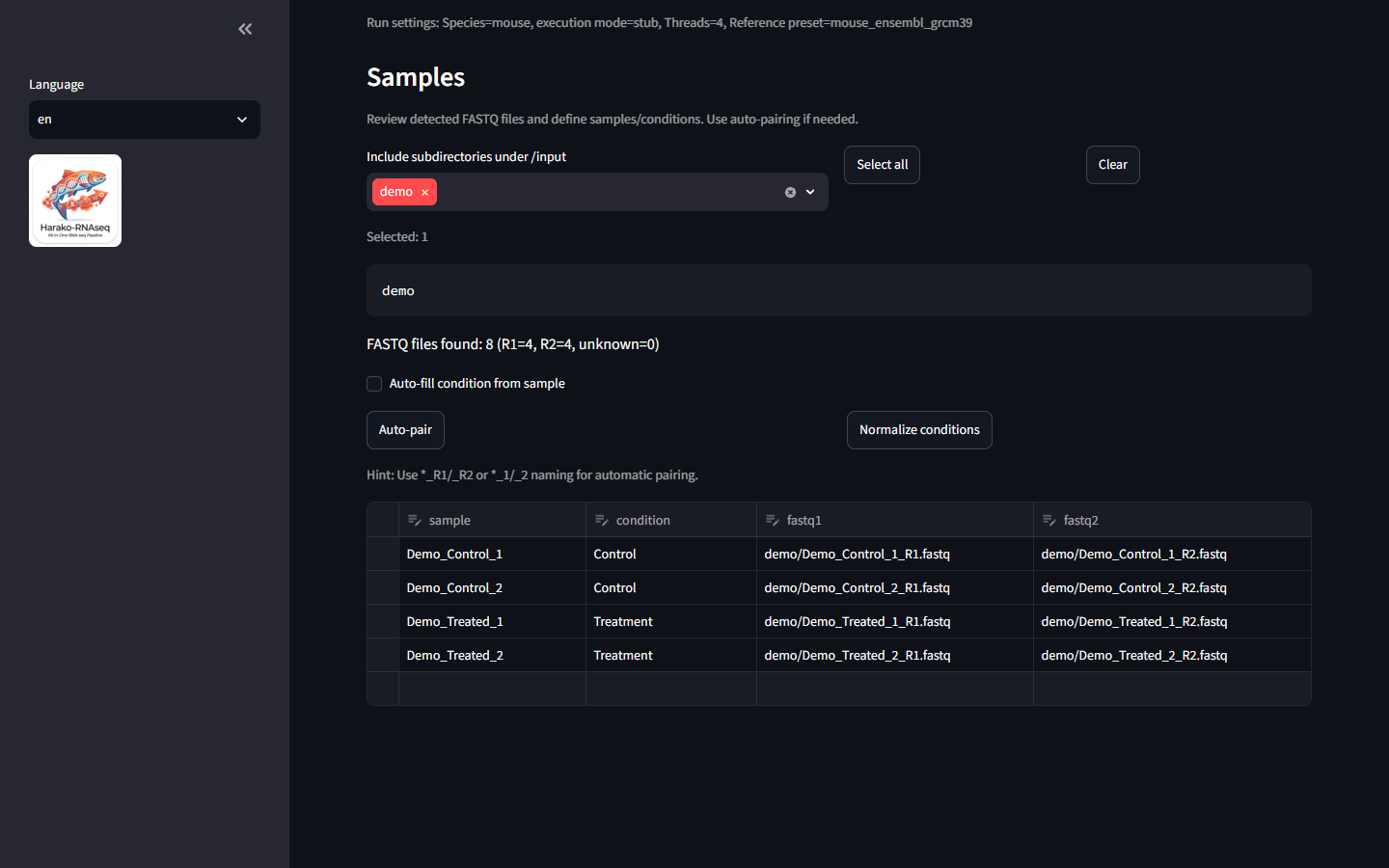
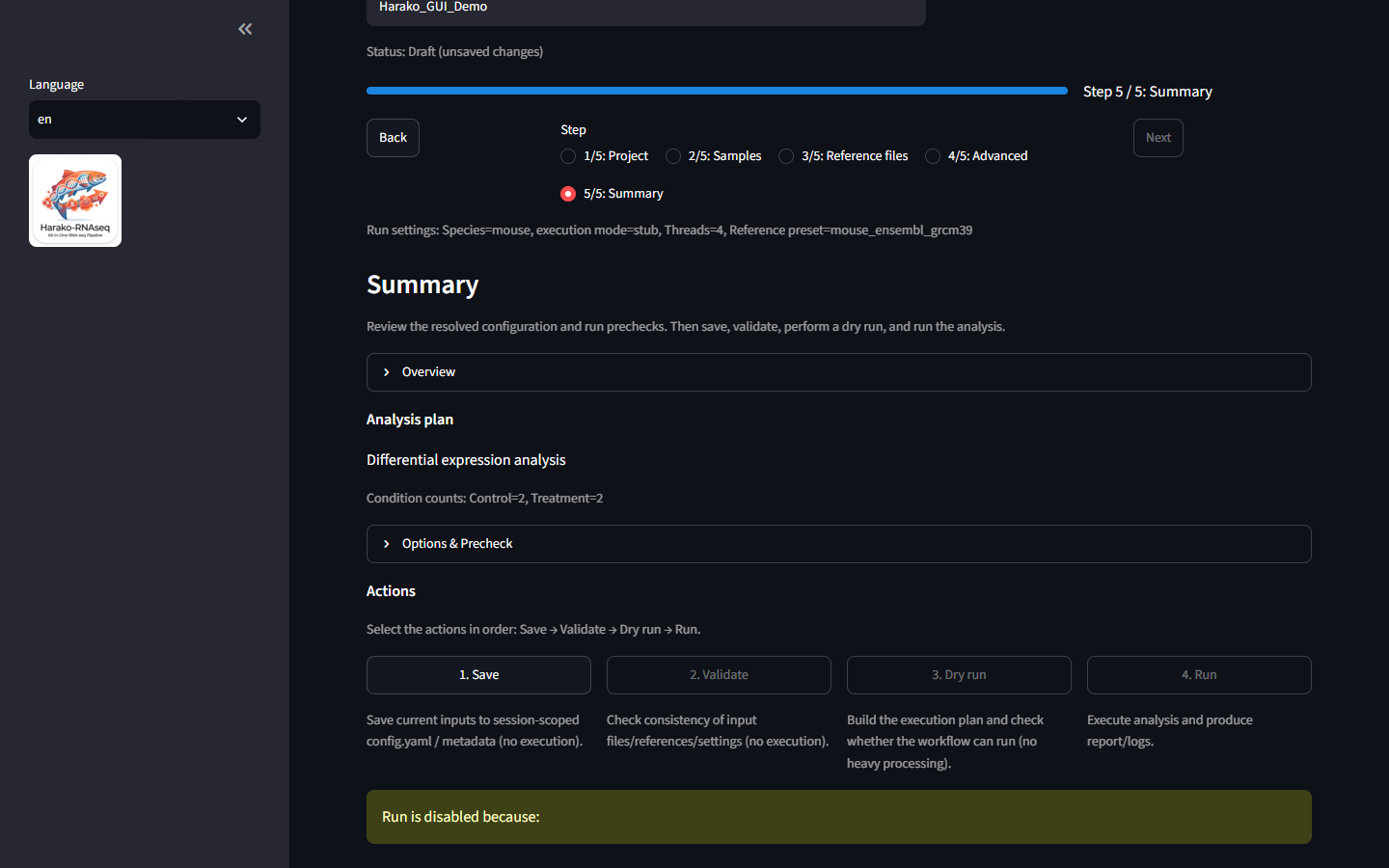
See the Harako interface

Review detected FASTQ files, sample assignments, references, and the analysis plan before starting a run.

Designed to avoid unsupported inference

Differential or QC-only

DESeq2 differential expression analysis requires at least two conditions and at least two valid samples in every condition. This is the minimum threshold enforced by the software, not a power calculation or evidence of biological independence or experimental-design validity. Inputs that pass structural validation but do not meet these minimum sample-count requirements continue in QC-only mode without p-values or adjusted p-values; inferential contrasts are inactive and enrichment is not run.

References with provenance

Checksum-pinned Ensembl presets cover human, mouse, and rat, and each run records reference provenance. Custom transcript FASTA, genome FASTA, and GTF inputs are supported, but compatibility remains the researcher's responsibility; hashes establish exact-file identity, not biological suitability.

FASTQ or SRA/ENA

Use local single-end or paired-end FASTQ data, or the supported SRA/ENA acquisition workflow. Source accession metadata is retained for review.

Counts and TPM

tximport produces gene-level counts and gene-level TPM as an abundance measure. DESeq2 uses counts, never TPM.

Portable reporting

Each completed run includes a self-contained HTML report at report/report.html, with no required web assets or analytics calls.

Fixed run inputs and resumable execution

Run-local inputs are immutable. The saved analysis plan determines whether differential or QC-only mode is used, and Snakemake can resume incomplete workflow steps.

When BAM and splice junctions are required

Need BAM, splice junctions, and GPU-assisted alignment? See the Harako-GPU research alpha.

Explore Harako-GPU

Explore the output files and report →

Name and design principle

Harako-RNAseq takes its name from harako—salmon roe—and also acknowledges ikra, the Salmon-centered RNA-seq pipeline that inspired the project. HARAKO is also used as a backronym for the current design philosophy: explicit human review, reproducible Run records, an integrated analysis kit, and controlled workflow orchestration.

Human-auditable means that relevant inputs, decisions, plans, provenance, and outputs can be reviewed by a person; it does not automatically certify scientific validity. Harako-RNAseq is independently implemented and is not an official successor to, or endorsed by, the ikra project.

Scope and licensing

Harako-RNAseq is source-available public beta software for academic and permitted noncommercial use under the PolyForm Noncommercial License 1.0.0. It is intended for local, single-user research workflows and is not clinically validated. Harako-RNAseq does not assess experimental design, biological independence, reference suitability, or statistical power. Users must manage data privacy and interpret results in the context of their study.

Read the license · 日本語で読む